
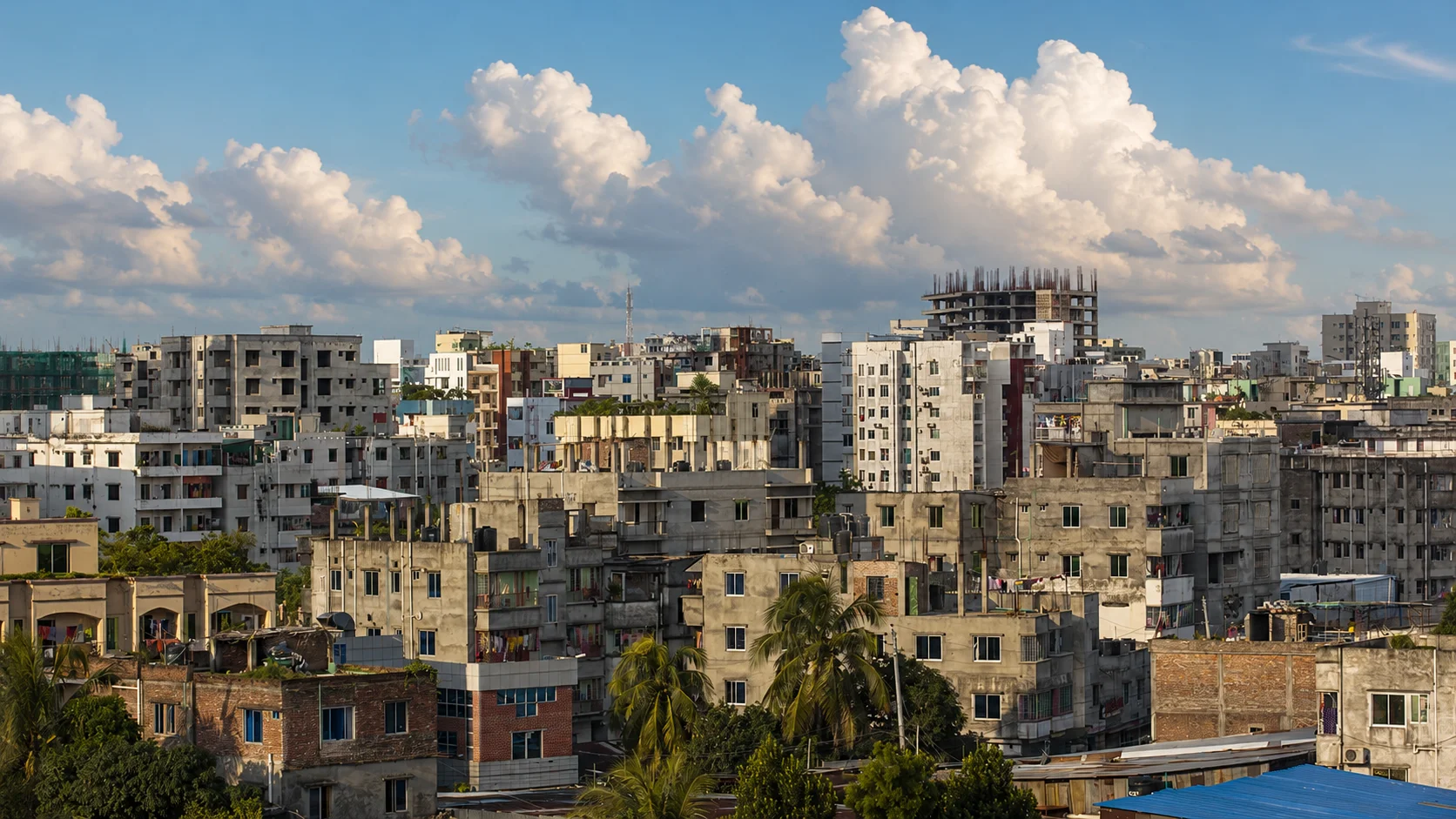
Khulna Real Estate for Investment – Opportunities for BuyersRiver city with brick homesand canals
Best offers
in Khulna
Benefits of investment in
Bangladesh real estate

Urban expansion driving residential demand
Dhaka continues to expand with infrastructure growth and middle-class housing needs.
Affordable entry into a growing market
Local pricing remains accessible while construction quality and amenities steadily improve.
Strong domestic demand in key cities
Rental demand is driven by a young, growing population seeking housing in urban zones.
Urban expansion driving residential demand
Dhaka continues to expand with infrastructure growth and middle-class housing needs.
Affordable entry into a growing market
Local pricing remains accessible while construction quality and amenities steadily improve.
Strong domestic demand in key cities
Rental demand is driven by a young, growing population seeking housing in urban zones.


Useful articles
and recommendations from experts
Real Estate in Khulna, Bangladesh
Why Invest in Property in Khulna
Khulna, the third-largest city in Bangladesh, is an emerging investment destination for real estate thanks to its strategic location near the Mongla Port, the Sundarbans mangrove forest, and major industrial zones. As a divisional capital and a transportation hub in the southwest, Khulna benefits from infrastructure projects, growing trade activity, and population growth. While it remains more affordable than Dhaka or Chittagong, Khulna offers stable demand for residential, commercial, and industrial properties, particularly in its urban core and port-adjacent zones.
Types of Property Available
Khulna’s real estate market features a variety of investment opportunities:
- Residential apartments — Concentrated in areas like Sonadanga, Nirala, and Khalishpur, serving middle- and upper-middle-class families.
- Independent homes — Still available in the city’s suburbs and older neighborhoods, with ample plot sizes.
- Commercial properties — Retail outlets, office spaces, and mixed-use buildings near KDA Avenue and Daulatpur.
- Industrial plots — Located near Mongla Port and in the Khulna Export Processing Zone (KEPZ).
- Land plots — Affordable and available across the division, particularly in Rupsha and Fulbarigate, for future residential or industrial development.
Ownership Rules and Legal Aspects
The ownership framework in Khulna follows the national legal structure of Bangladesh:
- Foreigners are restricted from owning land — However, long-term leases and investment via locally registered companies are possible.
- Residential units in private developments — May be accessible through partnership agreements with local entities.
- Registration process — Involves mutation, stamp duty (approximately 3%), and land record verification through the Sub-Registrar Office.
- Legal due diligence — Is vital due to risks like dual ownership claims, zoning irregularities, or inherited property complexities.
Price Ranges and Market Performance
Khulna offers some of the lowest urban real estate prices among major Bangladeshi cities, yet prices are gradually rising:
- Mid-range apartments: $350 – $600 per m² in Sonadanga, Nirala, and Khalishpur
- Independent houses: $45,000 – $100,000 for 2–4 bedroom homes
- Commercial units: $700 – $1,200 per m² in central business districts
- Industrial land: $70 – $200 per m² in areas near Mongla and KEPZ
- Land plots: $30 – $100 per m² depending on proximity to roads, ports, or rivers
- Residential rentals: 5%–7% annually, especially for well-located and furnished units
- Commercial rentals: 6%–9% in areas with high retail footfall or office demand
Best Neighborhoods for Property Investment
Several areas in Khulna stand out for real estate investment:
- Sonadanga — A prime residential zone with schools, hospitals, and shopping centers; ideal for apartments and family housing.
- Nirala — An upscale, quiet neighborhood with tree-lined streets and newer housing developments.
- Khalishpur — A mixed-use area with a strong industrial base and growing commercial appeal.
- Daulatpur — Known for educational institutions and increasing retail activity.
- Rupsha — Offers affordable land and housing near the river, with long-term development potential.
- Mongla and KEPZ Area — For industrial and logistics-focused investors, with proximity to port infrastructure.
Investment Scenarios and Buyer Profiles
Khulna attracts a wide range of investor profiles:
- Local buy-to-let landlords — Purchasing apartments to lease to professionals, students, or middle-income families.
- Diaspora investors — Acquiring homes for family use, retirement, or as a legacy investment.
- Retail and commercial buyers — Operating shops, clinics, or service businesses in growing urban corridors.
- Industrial developers — Securing plots near Mongla or KEPZ for warehousing, processing, or export-oriented manufacturing.
- Land speculators — Acquiring low-cost land near new road projects or economic corridors for future resale.
Risks and Challenges
Khulna’s property market, while stable, presents key challenges:
- Flood risk — Low-lying riverbank areas may experience seasonal flooding; proper elevation and drainage planning are important.
- Title complexity — Historical land records can be unclear; investors must conduct thorough legal reviews.
- Liquidity — Property sales may take longer in some zones, particularly for large land holdings.
- Developer reliability — Quality of construction varies; due diligence on builders is essential for apartments and mixed-use projects.
- Infrastructural lag — Some outer districts still lack paved roads, public utilities, or stable internet connectivity.
Conclusion: Who Should Invest in Khulna
Khulna is an attractive destination for investors seeking affordable entry points in a growing urban and port-driven economy. It is ideal for long-term residential landlords, industrial developers, and land bankers focused on secondary cities with strong fundamentals. While more conservative than Dhaka or Chittagong, Khulna offers resilience, gradual appreciation, and solid returns — particularly for those willing to explore regional urban growth corridors and industrial zones near Mongla.