
Propiedades en venta por el propietario en Vancouver (EE. UU.)Propiedades vendidas por sus propietarios con datos y precios transparentes
Mejores ofertas
en Washington
Real estate from owners in Vancouver (USA)


Value competition
The local market operates in Portland's shadow, creating distinct value corridors. Direct owner listings provide unfiltered price points for homes in established neighborhoods versus emerging areas, without commission inflation.
Transitional property insight
Sellers here often upgrade within the same market. Their firsthand account of a home’s evolution, system upgrades, and neighborhood changes provides a practical blueprint for its next phase of life.
Neighborhood reality check
A local owner explains the actual commute from Hough, the walk to amenities in Arnada, and the development plans near the Waterfront. This turns online maps and listings into a practical understanding of daily life.
Value competition
The local market operates in Portland's shadow, creating distinct value corridors. Direct owner listings provide unfiltered price points for homes in established neighborhoods versus emerging areas, without commission inflation.
Transitional property insight
Sellers here often upgrade within the same market. Their firsthand account of a home’s evolution, system upgrades, and neighborhood changes provides a practical blueprint for its next phase of life.
Neighborhood reality check
A local owner explains the actual commute from Hough, the walk to amenities in Arnada, and the development plans near the Waterfront. This turns online maps and listings into a practical understanding of daily life.








Artículos útiles
y recomendaciones de expertos
Navigating Vancouver (USA) property through direct owner engagement
Acquiring real estate in Vancouver places a buyer within a distinct and often misunderstood Pacific Northwest market, one defined by its own economic identity rather than merely its proximity to Portland. The city functions as a strategic urban center in Clark County, with a growing base in technology, healthcare, and advanced manufacturing that supports a residential market increasingly oriented toward local living. The geographic logic is clear, with historic neighborhoods clustered near a revitalized downtown core, post-war subdivisions extending to the east, and newer developments embracing more suburban and rural landscapes. This section presents sale by owner homes shown here from verified owners, offering a transparent conduit into a market where value perception and on-the-ground reality can diverge. For those prioritizing a direct line to a property’s history and its neighborhood’s authentic rhythm, this approach bypasses generalized narratives.
Positioning within a dual-market dynamic in Vancouver (USA)
Vancouver’s property market exists in a constant state of comparison, evaluated against both its own merits and the gravitational pull of the Oregon metro across the river. This creates a unique value proposition. Buyers reviewing listings here are often conducting a parallel analysis, weighing Washington’s lack of state income tax against specific neighborhood amenities, commute patterns, and lifestyle fit. The local economy, anchored by employers like PeaceHealth, Hewlett-Packard, and a burgeoning tech scene, generates organic demand independent of cross-border shopping. When individuals explore real estate for sale in Vancouver through direct channels, they seek to cut through this comparative noise. An owner can explain not just the floorplan, but the practical impact of a neighborhood’s walk score, the true traffic flow during commute windows from their specific street, and the community initiatives that define their area’s character. This grounded intelligence is critical for assessing a property’s intrinsic worth, separate from its position in a regional stereotype.
The architectural and developmental layers of housing stock in Vancouver (USA)
Residential inventory in Vancouver tells the story of sequential growth waves. The oldest housing, found in neighborhoods like Hough and Carter Park, consists largely of early 20th century Craftsman bungalows and Dutch Colonials, many thoughtfully updated. These homes offer established streetscapes and mature landscaping. The post-war boom filled vast tracts to the east, including the Rose Village and Ogden neighborhoods, with modest, functional ranch homes that now represent a core of attainable, single-family stock. The late 20th and early 21st centuries saw the development of master-planned communities like Fisher’s Creek and Brandywine, introducing newer construction with modern layouts and homeowners associations. The most contemporary phase is visible in the downtown waterfront condominiums and townhomes, catering to an urban professional demographic. Meanwhile, the fringes of the city and incorporated county areas offer properties ranging from standard subdivisions to homes on larger, semi-rural lots. Owner published listings available for this location must therefore specify the generation of development, the nature of any remodeling, and the balance between private space and community-provided amenities.
The mechanics of a direct transaction in a practical market of Vancouver (USA)
The process for a private sale in Vancouver reflects the no-nonsense Pacific Northwest ethos. Sellers opting for this route are expected to have prepared the property disclosure form, a preliminary title report, and documentation for any major repairs or system replacements. In a market sensitive to value, recent utility bills and property tax statements are often shared to provide a full cost picture. Engagement with a no agent property listing typically leads to a direct, information-focused viewing. The seller’s role expands to that of a local guide, able to clarify the specific permitting history of a finished basement, the performance of the roof in seasonal rains, the patterns of sunlight in the backyard, and the track record of the local school district from a parent’s perspective. Negotiation is direct, often referencing recent, verifiable sales of comparable properties pulled from public records. The closing is facilitated by a title and escrow company, standard for Washington State, ensuring legal transfer while the principals have managed the substantive terms without intermediary layers.
Valuation drivers in a layered urban field in Vancouver (USA)
Price formation here is influenced by a matrix of accessibility, neighborhood prestige, and home modernity. Premiums are attached to properties within the walkable zones of downtown and the historic districts, as well as to those with commanding views of the Columbia River or Mount Hood. There is a tangible price differential between these areas and the solid, value-oriented neighborhoods of East Vancouver, though this gap is nuanced by the condition and size of the home itself. The market places a high value on move-in readiness and energy efficiency, with updated mechanical systems and insulation often returning strong value. Newer construction in managed communities commands a price per square foot that reflects modern standards and low maintenance covenants. Buyers examining owner published listings can decode this structure, seeing how a budget may align with a renovated classic close to the core, a larger but dated home on a generous lot further out, or a low-maintenance townhome in a newer node. Direct listings make these trade-offs explicit, as the seller’s narrative explains the ‘why’ behind the price.
The neighborhood spectrum in Vancouver (USA): from urban core to forest edge
Understanding Vancouver requires moving beyond a monolithic view to its composite parts, each with a defined role.
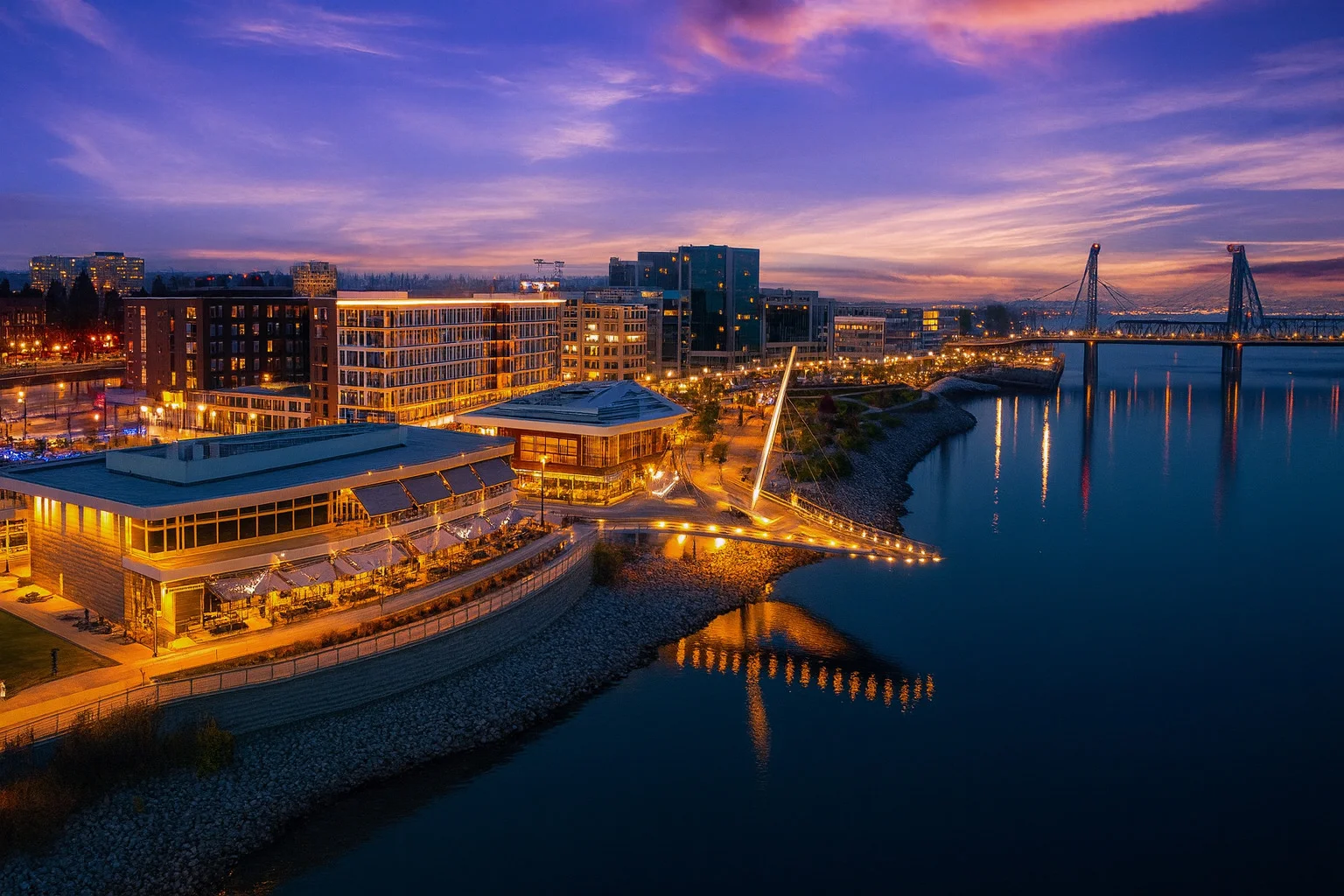
Downtown Vancouver and the Historic Waterfront represent the city’s urban revitalization core, with a mix of new apartment buildings, converted lofts, and condominiums. This area is defined by its walkability to restaurants, the public market, and Esther Short Park, appealing to professionals and those seeking a car-light lifestyle.
Hough and Carter Park are established historic neighborhoods directly north of downtown. Characterized by tree-lined streets, classic architecture, and a strong sense of community, these areas attract those who value proximity to the urban core with the feel of a settled residential district.
Arnada, nestled between downtown and the I-5 corridor, is an eclectic, walkable neighborhood with a mix of historic homes, local businesses, and a vibrant arts community. It offers a distinct, engaged neighborhood identity.
Rose Village and Ogden are classic mid-century residential areas, offering primarily single-family ranch homes on well-sized lots. These neighborhoods represent the affordable backbone of the city, popular with first-time buyers and families seeking value and stability.
East Vancouver encompasses a vast area of suburban development from the 1970s to the present. It includes numerous subdivisions, shopping centers, and schools, catering to families looking for more space, newer homes, and a traditional suburban lifestyle.
Felida and Salmon Creek are northern suburban areas known for higher-end homes, top-rated schools, and a more pastoral setting with larger lots and views. These communities appeal to families and professionals seeking premium amenities and perceived prestige.
Rural Clark County, on the city’s fringes, offers properties ranging from equestrian estates to homes on acreage, providing privacy and a connection to the land for those willing to commute.
The contemporary buyer constituency in Vancouver (USA)
The flow of purchasers into Vancouver’s market is multifaceted. A significant portion consists of local move-up buyers—residents capitalizing on equity to transition from a starter home in Ogden to a larger property in Fisher’s Landing, for instance. Their deep local knowledge makes them keen reviewers of direct listings. Another substantial cohort includes professionals relocating for positions at the Port of Vancouver, PeaceHealth, or tech firms, who are often comparing living costs and lifestyles on both sides of the Columbia River. Remote workers, empowered to choose their location, are increasingly drawn by the quality of life and tax advantages, often seeking homes with dedicated office space. Additionally, the market sees investors focused on the steady rental demand fueled by the stable job base. Crucially, the narrative from an owner-listed property is vital for all these groups. It provides the unwritten details: the true nature of a neighborhood’s community association, the realistic commute time to a specific employer, the performance of a garden in the local microclimate, and the history of any neighborhood disputes or improvements.
Illustrative acquisition pathways via direct sale in Vancouver (USA)
A software engineer, newly remote, sought a home with a view, space for a studio, and fiber internet. Bypassing traditional agents, they found an owner-listed mid-century modern in the Rose Village area. The seller, a former telecom worker, had detailed documentation on the CAT-6 wiring installation, the seasonal sightlines to Mount St. Helens, the neighborhood’s petition for fiber expansion, and the quiet work-from-home culture on the block. This highly specific, technical insight aligned perfectly with the buyer’s core needs.
A family moving from Portland for more space and Washington schools targeted the Hough neighborhood. A direct listing for a Craftsman included a portfolio from the owner, an architect, showing the respectful kitchen expansion, the seismic retrofit details, the names of the local teachers, and the block’s tradition of a summer potluck. This narrative of thoughtful stewardship and community cemented their choice.
An investor looking for a turnkey rental property focused on condominiums near the hospital. The owner of a two-bedroom unit provided two years of property management statements, a history of HOA fee increases and special assessments, demographic data on typical renters (often traveling nurses), and notes on the building’s soundproofing. This unvarnished operational data formed the basis for a solid investment analysis.
Critical owner-mediated inquiries for Vancouver buyers
What is the specific history of water management and foundation health, given the regional precipitation? In older homes, drainage solutions and past waterproofing efforts are key. Owners can provide details on gutter systems, sump pump history, and any foundation crack monitoring, offering peace of mind beyond a standard inspection report.
How do the traffic and commute patterns actually function from this specific location? Proximity to a highway on-ramp is one thing; the experience of merging at 7:45 AM is another. An owner can describe the real-world commute to major employment centers, including back-road alternatives they’ve developed over years.
What are the tangible differences in community atmosphere and rules between an HOA and a non-HOA neighborhood? Some buyers seek the uniformity and maintained common areas of an HOA; others prioritize the freedom of a covenant-free street. An owner can explain the practical enforcement, fee utility, and social dynamics of their specific situation.
What is the realistic cost of ownership beyond the mortgage—property taxes, utilities, and expected maintenance for this home’s age and type? Sellers can share recent bills and a candid overview of upcoming maintenance milestones (e.g., roof age, furnace servicing), which is invaluable for accurate financial planning.
How has the neighborhood changed in the last five years, and what is its perceived trajectory? An owner’s perspective on new developments, shifts in resident demographics, and community advocacy efforts provides a forward-looking context that static data cannot.
The distinct in Vancouver (USA) rationale for direct sourcing in market
Choosing to explore the real estate for sale in Vancouver through direct owner listings is a deliberate strategy for gaining qualitative leverage in a quantitatively transparent market. It privileges the narrative and the lived experience over the merely transactional. In a city forging its own identity amidst regional comparisons, the owner’s story provides the critical connective tissue between a property’s specifications and its role in a daily life. This pathway demystifies the process of buying homes, transforming it from a comparison of features into an assessment of fit, potential, and community. For the buyer whose goal is to find a property understood in full context—its past upgrades, its present utility, and its neighborhood’s future—initiating the search through these transparent, commission-free channels is the most coherent and resourceful method. It establishes a foundation of mutual understanding and factual clarity, which is the essential prerequisite for a confident investment in this evolving Pacific Northwest city.