
Commercial real estate in North Rhine-WestphaliaSelected assets for regional growth
Best offers
in North Rhine-Westphalia
Benefits of investing in commercial real estate in North Rhine-Westphalia


Polycentric demand
This region matters because Cologne, Dusseldorf, the Ruhr and the Rhine corridor create several commercial markets inside one territory, so value comes from how those nodes connect rather than from one dominant centre
Node discipline
Office and mixed-use assets fit best around Cologne and Dusseldorf, while logistics, trade and industrial formats read strongest near Duisburg and the Ruhr, where access, labour depth and supply-chain utility clearly overlap
Average trap
Many buyers compare the region through central office pricing, yet stronger judgment comes from node role, because a Duesseldorf office, a Dortmund trade site and a Duisburg warehouse serve completely different occupier patterns
Polycentric demand
This region matters because Cologne, Dusseldorf, the Ruhr and the Rhine corridor create several commercial markets inside one territory, so value comes from how those nodes connect rather than from one dominant centre
Node discipline
Office and mixed-use assets fit best around Cologne and Dusseldorf, while logistics, trade and industrial formats read strongest near Duisburg and the Ruhr, where access, labour depth and supply-chain utility clearly overlap
Average trap
Many buyers compare the region through central office pricing, yet stronger judgment comes from node role, because a Duesseldorf office, a Dortmund trade site and a Duisburg warehouse serve completely different occupier patterns








Useful articles
and recommendations from experts
Commercial property in North Rhine-Westphalia by urban chain
Commercial property in North Rhine-Westphalia matters because this region does not behave like one city with supporting suburbs. It behaves like a chain of large urban economies tied together by the Rhine, the Ruhr, dense motorways, rail corridors and a very broad labour base. Cologne, Dusseldorf, Duisburg, Dortmund, Essen, Bonn, Aachen and many other centres all carry real commercial weight, but they do not carry it in the same way. That is what makes the region commercially powerful and what also makes it easy to misread.
A buyer looking for one simple regional logic usually gets North Rhine-Westphalia wrong. It is not only an office market, not only an industrial market and not only a logistics market. It is all three at once, plus a large service and retail economy built on daily movement between many cities. The strongest reading begins with one idea: the region is polycentric. Buildings gain value not only from being central, but from belonging clearly to one of the region's working nodes. VelesClub Int. helps structure that reading so that unlike assets are not forced into one average.
North Rhine-Westphalia works as a chain of cities
What makes North Rhine-Westphalia different from many European regions is that commercial demand is spread across several serious centres rather than stacked into one dominant capital. Dusseldorf and Cologne carry strong office and service depth. Duisburg gives the region major inland logistics relevance. The Ruhr cities keep industrial, trade and urban service demand broad. Bonn and Aachen add public-facing, research and specialist business activity. This means the region works more like a linked commercial system than a hierarchy with one clear top and weaker outer rings.
That changes how buyers should compare assets. A building does not become strong here only because it sits in the most expensive postcode. It becomes strong when it fits the exact function of its node. In North Rhine-Westphalia, a smaller unit in the right city can be more practical than a larger asset in the wrong one because daily flows of workers, goods and services are distributed through many centres, not through one address.
Dusseldorf and Cologne anchor office space in North Rhine-Westphalia
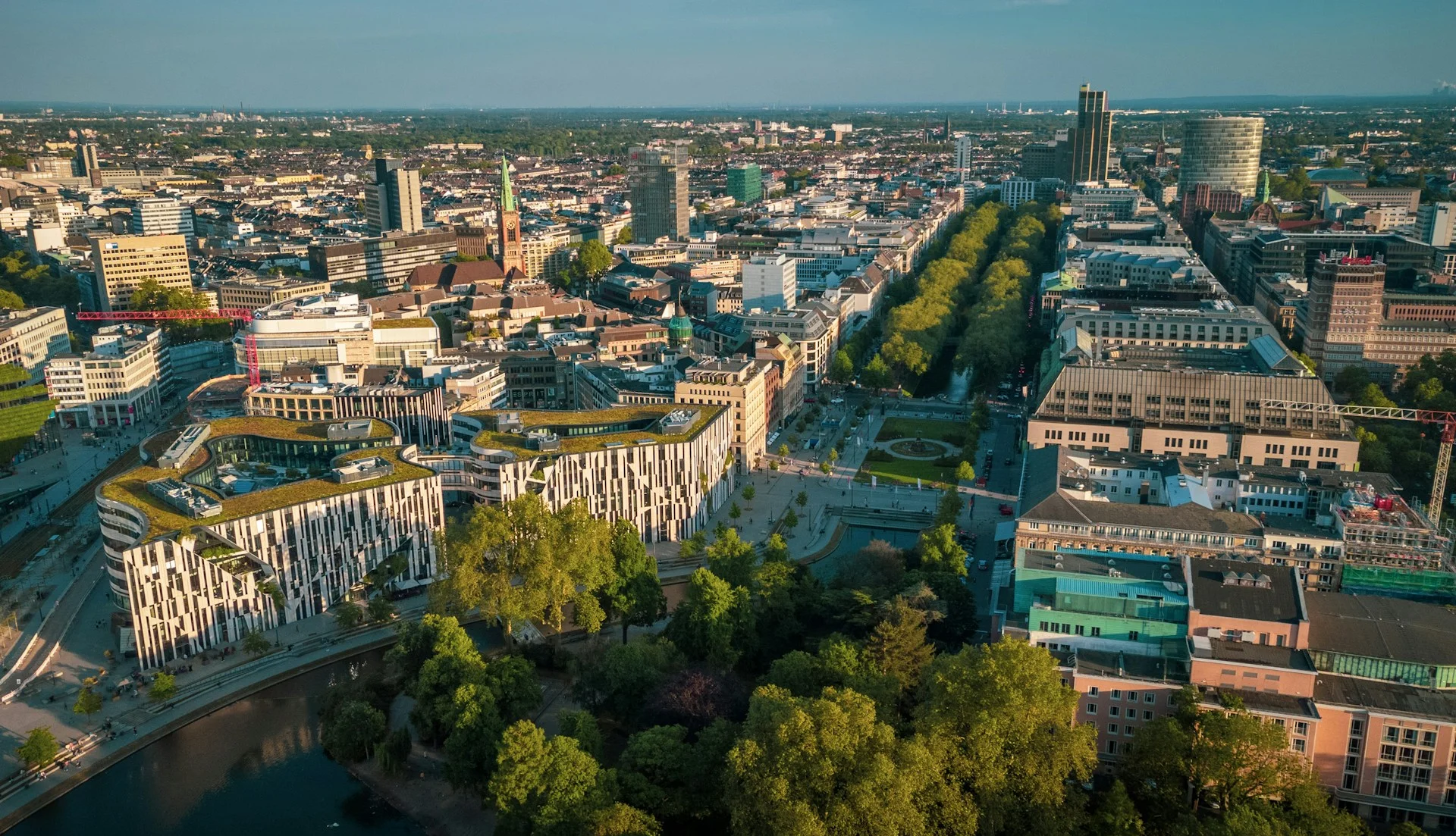
Office space in North Rhine-Westphalia is strongest when read through Dusseldorf and Cologne together rather than through one city alone. Dusseldorf carries finance, advisory work, premium services and a stronger corporate office profile. Cologne adds media, trade, legal work, healthcare, education and one of the broadest mixed-use urban economies in the region. Both cities support offices, service-led buildings, hotels, food-led premises and district retail, but they do so with slightly different occupier patterns.
For buyers, that means office property in North Rhine-Westphalia should not be judged through one central benchmark only. A Dusseldorf office building may depend more on corporate and professional density. A Cologne mixed-use block may derive more of its strength from overlap between offices, services, hospitality and everyday urban life. VelesClub Int. helps compare those office markets through role and occupier logic rather than through one generic regional office story.
In North Rhine-Westphalia the Ruhr changes asset hierarchy
The Ruhr gives the region a commercial layer that many buyers simplify too quickly. It is easy to call it industrial and stop there, but that misses the point. Dortmund, Essen, Bochum and surrounding cities support offices, urban retail, healthcare, education, practical business services, trade premises and industrial-support property at the same time. The Ruhr is not important because it is one giant factory belt. It is important because it turns former heavy-industry geography into a broad working urban market with many occupier types.
That shifts asset hierarchy. In the Ruhr, a mixed-use building, a trade-oriented site or a practical office can be commercially convincing even without prime-city image because local labour, dense population and daily business use remain strong. North Rhine-Westphalia becomes more readable once the Ruhr is treated as a dense multi-city service and production system rather than as a background industrial zone.
Duisburg makes warehouse property in North Rhine-Westphalia strategic
Warehouse property in North Rhine-Westphalia becomes structurally important around Duisburg and the broader Rhine-Ruhr logistics geography. This is where inland port activity, motorway access, rail movement and industrial servicing all reinforce one another. The strongest reading is not logistics by label alone. The stronger reading is movement of goods through a region that already has huge local consumption, manufacturing and trade demand. That is why the warehouse story here is more than simple transit.
This changes the way industrial and storage assets should be judged. A warehouse or trade-support unit in the right Rhine-Ruhr location may be commercially stronger than a more visible building elsewhere if it solves a real operating problem. In this part of North Rhine-Westphalia, loading, yard function, route fit and replacement difficulty often matter more than image. Anyone looking to buy commercial property in North Rhine-Westphalia for practical income should treat logistics and support property as one of the region's core strengths, not as a side category.
Bonn and Aachen broaden commercial real estate in North Rhine-Westphalia
Bonn and Aachen keep the region from becoming too dependent on Rhine-Ruhr and Cologne-Dusseldorf logic. Bonn carries public-facing services, international functions, healthcare, research and a stable office environment with a different tone from the larger Rhine cities. Aachen adds engineering, cross-border business, education and technical activity that make offices, service property and selected commercial space read differently from the rest of the region.
For buyers, this matters because these cities widen the commercial map. A building in Bonn may make sense because of continuity and institutional demand. A building in Aachen may be stronger through research, technical labour and border-facing economic links. In North Rhine-Westphalia, those specialist nodes make the market more balanced and give buyers more than one credible entry point beyond the usual headline cities.
Retail space in North Rhine-Westphalia follows town centres not one high street
Retail space in North Rhine-Westphalia is too broad to judge through one prime shopping street model. The region supports food-led trade, healthcare-linked retail, convenience units, restaurants, beauty services, mixed-use high streets and suburban service clusters across many cities of different sizes. That matters because a large part of the region's commercial life depends on repeated local use rather than on destination spending alone. A district centre in Essen, a service parade in Bonn or a food-led mixed-use unit in Cologne do not belong to the same trading pattern even if all three count as retail.
This is why the region rewards careful selection. A smaller service-led unit in the right local centre can be more durable than a louder address with weaker daily continuity. Good retail reading in North Rhine-Westphalia begins with catchment, access, district role and the type of spending the premises are built to capture. The strongest units usually belong to everyday movement, not to image alone.
What makes one asset stronger in North Rhine-Westphalia
The region does not reward every commercial format equally in every node. Office and mixed-use urban property fit best in Dusseldorf, Cologne and selected specialist centres. Industrial and trade-support assets fit strongly in the Ruhr and along practical production and movement corridors. Warehouse property is most convincing where Rhine-Ruhr access and servicing needs overlap clearly. Retail and service premises can work across a wider geography when town-centre function and daily use are strong. That unevenness is not a weakness. It is exactly what gives the region depth.
A stronger approach is therefore to compare buildings by the job they do inside the region, not by one price ladder. VelesClub Int. helps make that distinction visible. In a region this polycentric, the best asset is rarely the one that merely borrows the most famous city name. It is the one that fits its node with the least friction and the clearest occupier logic.
Questions that sharpen North Rhine-Westphalia commercial property
Why can a Ruhr asset be more practical than a more expensive office in one of the headline cities
Because the Ruhr still carries dense labour, strong daily services, healthcare, education and practical business demand. A building there can have clearer local use and steadier occupier logic than a more expensive asset driven mainly by image.
When is warehouse property in North Rhine-Westphalia more convincing than buyers first expect
Usually when it sits in the Rhine-Ruhr logistics geography where inland port activity, motorway access and industrial servicing overlap. In those locations, route fit and operational relevance can outweigh broader regional visibility.
Why should buyers not compare Cologne and Dusseldorf as if they were interchangeable office markets
Because they attract different occupier mixes. Dusseldorf often reads more strongly through corporate and premium service demand, while Cologne usually carries a broader overlap between offices, media, services, hospitality and mixed-use urban continuity.
What makes a retail unit in North Rhine-Westphalia stronger than its frontage suggests
Repeated daily use. In this region, retail is often strongest where food, services, healthcare and errands create durable local demand rather than where a unit simply benefits from a more fashionable address.
Why do practical business nodes matter so much in North Rhine-Westphalia
Because the region works through connection. Cities, ports, trade zones and service centres reinforce one another, so buildings that sit in the right working node often outperform assets that look stronger but belong to a weaker local pattern.
A more exact reading of North Rhine-Westphalia
North Rhine-Westphalia is commercially relevant because it combines several working markets inside one dense western German territory. Dusseldorf and Cologne anchor office and service depth. The Ruhr broadens the urban industrial and practical business story. Duisburg and the Rhine-Ruhr belt make warehouse property structurally important. Bonn and Aachen widen the specialist office and research layer. Retail and daily service demand remain spread across many city centres rather than trapped in one core.
The strongest way to read commercial property in North Rhine-Westphalia is therefore by node role, corridor access, city function and continuity of demand. Different assets make sense here for different reasons, and the region rewards buyers who match format to local function instead of chasing one simplified Rhine-Ruhr narrative. VelesClub Int. helps turn broad interest in North Rhine-Westphalia into a calmer and more practical commercial framework.