
Commercial property in Vancouver (USA)City assets with business clarity
Best offers
in Washington
Benefits of investing in commercial real estate in Vancouver (USA)


Regional demand drivers
Vancouver's location on the I-5 corridor and Columbia River port drives demand from logistics, trade and regional healthcare and public sector employers, supporting stable industrial and institutional leases alongside shorter-term neighborhood retail profiles
Asset types and strategies
Industrial and warehouse near the port, medical and public-sector office downtown, and neighborhood retail and hospitality corridors dominate; strategies range from core long-term industrial leases to value-add office repositioning and single-tenant retail leasing
Expert selection support
VelesClub Int. experts define strategy, shortlist assets and run screening including tenant quality checks, lease structure review, yield logic assessment, capex and fit-out assumptions, vacancy exposure analysis and a disciplined due diligence checklist
Regional demand drivers
Vancouver's location on the I-5 corridor and Columbia River port drives demand from logistics, trade and regional healthcare and public sector employers, supporting stable industrial and institutional leases alongside shorter-term neighborhood retail profiles
Asset types and strategies
Industrial and warehouse near the port, medical and public-sector office downtown, and neighborhood retail and hospitality corridors dominate; strategies range from core long-term industrial leases to value-add office repositioning and single-tenant retail leasing
Expert selection support
VelesClub Int. experts define strategy, shortlist assets and run screening including tenant quality checks, lease structure review, yield logic assessment, capex and fit-out assumptions, vacancy exposure analysis and a disciplined due diligence checklist








Useful articles
and recommendations from experts
Practical commercial property in Vancouver (USA) Market
Why commercial property matters in Vancouver (USA)
Vancouver (USA) supports a diversified local economy that drives steady demand for commercial space across multiple sectors. The city combines a government and regional services base with logistics nodes tied to the Columbia River corridor, a concentration of healthcare and education providers, and a tourism and hospitality presence linked to cross-river commuters and weekend visitors from the Portland metropolitan area. Office requirements are anchored by municipal, professional, and technical services. Retail demand reflects both local household spending and commuter traffic. Hospitality captures short-stay business and leisure guests, while healthcare and education generate long-term lease needs that can underpin investment cashflow. Industrial and warehousing demand responds to regional supply chain flows and last-mile delivery in the Portland–Vancouver metro area. Buyers in this market include owner-occupiers seeking operational control, institutional and private investors focused on income, and operators who manage multi-tenant assets or specialized properties. Each buyer type evaluates the same local fundamentals differently – lease stability for investors, functional layout for owner-occupiers, and operating efficiencies for operators.
The commercial landscape – what is traded and leased
The stock of commercial real estate in Vancouver (USA) is a mix of compact business districts, high street retail corridors, neighborhood shopping nodes, suburban business parks, and logistics zones near highway interchanges. Downtown Vancouver and the waterfront corridor host higher-density office leases and tourism-oriented ground-floor retail, while areas such as Fishers Landing and the Vancouver Mall corridor concentrate larger format retail, automotive services, and consumer-oriented tenants. Industrial and warehouse property in Vancouver (USA) clusters around arterial highways and interchanges that provide access to I-5 and I-205; these assets serve regional distribution and light manufacturing. Lease-driven value predominates in smaller retail and service properties where tenant cashflow and renewal probabilities determine capitalisation. Asset-driven value is more pronounced in larger office buildings and industrial parks where redevelopment potential, zoning and alternative-use options change underlying value. Understanding which component dominates a given transaction is essential for pricing and risk assessment.
Asset types that investors and buyers target in Vancouver (USA)
Retail space in Vancouver (USA) spans high street storefronts in downtown blocks, neighborhood retail strips near residential catchments, and big-box formats along primary arterial routes. High street retail typically trades on visibility and pedestrian activity and is sensitive to short-term vacancy and turnover, while neighborhood centers derive value from stable resident demand. Office space in Vancouver (USA) ranges from small professional suites suitable for medical and legal practices to multi-tenant mid-rise buildings used by engineering, finance, and public administration tenants. Prime office logic emphasizes location close to public services and transit, while non-prime office decisions focus on lease flexibility and lower operating costs. Hospitality assets capture seasonal and business travel patterns; investors evaluate occupancy cycles and brand-agnostic operating efficiency. Restaurant, cafe, and bar premises are a specific subcategory where lease length and fit-out responsibilities materially affect value. Warehouse property in Vancouver (USA) and light industrial buildings reflect e-commerce and supply chain dynamics – proximity to interstate access, ceiling height, loading configuration, and local labor supply are key. Mixed-use and revenue houses combine ground-floor commercial leases with upper-floor residential income and are considered where zoning and occupancy patterns support densification or repositioning. Serviced office and flexible workspace concepts exist as overlays in selected buildings but require careful underwriting of churn and management capability. Across segments, investors compare yield expectations against lease terms and capex needs, and they factor in local planning constraints and tenant demand trends.
Strategy selection – income, value-add, or owner-occupier
Commercial property strategies in Vancouver (USA) generally fall into three categories. Income-focused strategies prioritize stabilized assets with long-term leases, creditworthy tenants, and predictable service-charge structures; these are often favored where tenant quality and lease length reduce reletting risk. Value-add investors target assets with operational or physical improvement potential – examples include repositioning outdated retail strips, consolidating small office suites into modern floor plates, or improving logistics yard configuration to attract higher rents. The viability of value-add depends on local permit timelines, market absorption rates, and sensitivity to business cycles in Vancouver (USA). Mixed-use optimization blends residential and commercial repositioning to increase net operating income where zoning and market demand allow. Owner-occupiers pursue purchases to secure occupancy certainty and control over fit-out and lease expiries; decisions for owner-occupiers hinge on projected occupancy needs and the comparative cost of leasing versus owning in the local market. Local factors that push one strategy over another include seasonal tourism patterns that affect hospitality income, tenant churn norms in retail corridors, and regulatory intensity related to permitting and environmental compliance. Risk appetite, capital availability, and time horizon determine which strategy is appropriate for a given buyer or investor.
Areas and districts – where commercial demand concentrates in Vancouver (USA)
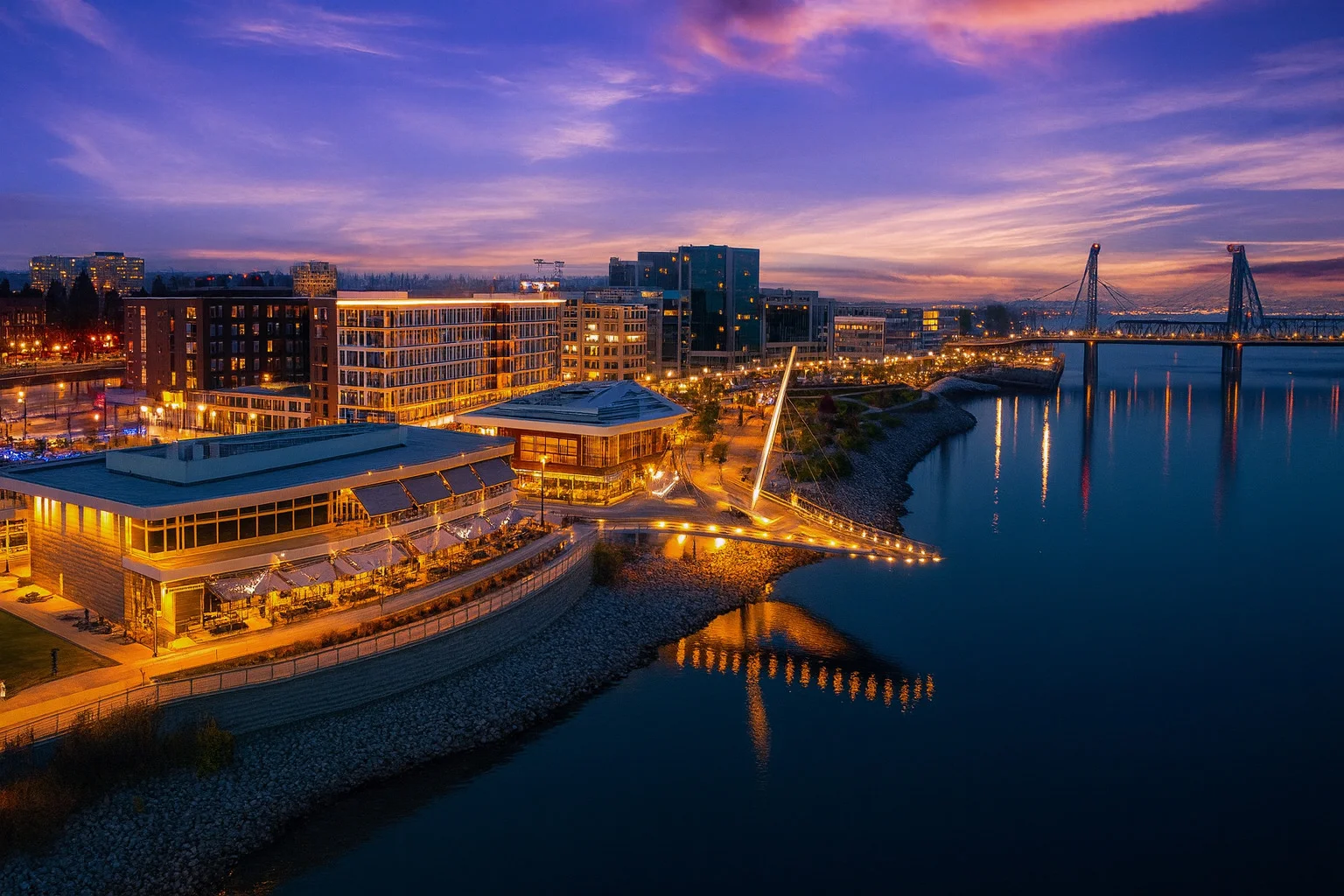
Commercial demand in Vancouver (USA) concentrates along a handful of repeatable district types rather than evenly across the city. The central business district and the Vancouver waterfront corridor remain primary markets for office space and hospitality due to proximity to government services, transit, and visitor flows. Suburban commercial corridors such as the Fishers Landing and Vancouver Mall areas concentrate large-format retail, consumer services, and regional draw. Northern corridors including Salmon Creek and Hazel Dell offer logistics and neighborhood retail exposure, with parcels better suited to warehouse and light industrial adaptation. Uptown and established neighborhood nodes support professional services, medical practices, and local-oriented retail. When evaluating districts, investors should assess commuter flows, public transport connectivity, the presence of institutional employers, and the balance of residential catchment versus transient demand. Oversupply risk is greatest in suburban retail corridors where new development can outpace local spending, whereas industrial access and last-mile routes dictate demand for warehouse property in Vancouver (USA).
Deal structure – leases, due diligence, and operating risks
Typical buyer reviews in Vancouver (USA) focus on lease structure, tenant credit, and the physical condition of the asset. Key lease elements include term length, break options, indexation provisions, responsibility for common area maintenance and utilities, and tenant fit-out obligations. Buyers model vacancy and reletting risk by analyzing historical turnover, market rent comparables, and lease expiries clustered within short windows. Due diligence covers building systems, compliance with code and environmental standards, capital expenditure forecasting, and service-charge reconciliation. Operating risks in the local context include tenant concentration, exposure to seasonal retail swings, and infrastructure constraints that may affect access or utility reliability. For industrial properties, site access and pavement condition are practical diligence items that affect operating cost. Financial diligence should align lease roll projections with stress-tested scenarios for rent growth and downtime. VelesClub Int. assists clients in structuring diligence to surface lease-related risks, capex timing, and tenant fragility without providing legal advice.
Pricing logic and exit options in Vancouver (USA)
Pricing drivers for commercial assets in Vancouver (USA) combine location attributes, tenant quality and lease length, building condition, and the potential for alternative use. Location metrics include visibility, footfall for retail, proximity to employers for office space, and highway access for warehouse property in Vancouver (USA). Tenant quality and remaining lease term are primary determinants of current income valuation; newer leases with long remaining terms and investment-grade tenants command pricing premiums, while short leases or retail tenants with volatile sales profiles reduce certainty. Building quality and immediate capex needs influence required return and hold-versus-reposition decisions. Alternative use potential – such as conversion of underutilized office floors to residential or adaptive reuse of older industrial sites – adds optionality that underwrites higher bids when zoning and market demand align. Exit options include holding to capture stabilized income and refinancing against improved cashflow, re-leasing short-term vacant space before sale to enhance sale proceeds, or executing a repositioning program and selling on an expanded income basis. Each exit path requires realistic assumptions about local leasing velocity, permit timelines, and market liquidity in Vancouver (USA).
How VelesClub Int. helps with commercial property in Vancouver (USA)
VelesClub Int. structures commercial asset support as a process aligned to client objectives. First, the firm clarifies investment and operational goals including target yield, acceptable asset classes, and timeframe for hold or disposition. Second, VelesClub Int. refines a target segment and district list tailored to those objectives, drawing on market intelligence specific to Vancouver (USA). Third, the team shortlists assets based on lease profile, tenant composition, physical condition, and downside scenarios, prioritizing opportunities that fit the client risk appetite. Fourth, VelesClub Int. coordinates due diligence workflows, ensuring technical, financial, and market reviews focus on core risk drivers such as lease roll, capex exposure, and reversion assumptions. Finally, the firm supports negotiation and transaction steps by aligning commercial terms to the agreed strategy and by preparing decision frameworks that the buyer or investor can use through closing. All work is customized to the client’s capabilities and market objectives; VelesClub Int. does not provide legal advice but facilitates the commercial and operational coordination required for a successful acquisition.
Conclusion – choosing the right commercial strategy in Vancouver (USA)
Selecting the correct commercial strategy in Vancouver (USA) depends on matching asset type, district dynamics, and lease structure to investor goals. Income-oriented buyers prioritize lease length and tenant quality, value-add operators focus on repositioning potential and capex timelines, and owner-occupiers weigh operational needs against the local cost of occupancy. A disciplined appraisal of district supply and demand, lease risk, and exit options will clarify whether to buy commercial property in Vancouver (USA) or pursue alternative tactics. For tailored screening, scenario planning, and asset selection support, consult VelesClub Int. experts who can align strategy, shortlist opportunities, and coordinate the due diligence and transaction steps required for informed decision-making.