
Commercial real estate for sale in OregonStrategic assets for regional acquisition

Popular
cities and regions in USA

Best offers
in Oregon
Benefits of investing in commercial real estate in Oregon


Split markets
Oregon matters because Portland, the Valley, and Central Oregon produce different tenant behavior, so buyers can move between service, industrial, medical, and hospitality demand without forcing one statewide pricing model
Task fit
The strongest fit changes quickly in Oregon: mixed business and selective office in Portland, practical industrial in the Valley, and medical, service, or hospitality property where local user patterns are already clear
False signals
Buyers often misread Oregon through Portland headlines or tourism language, but stronger value usually comes from what the building actually does: serve offices, hospital traffic, local spending, industrial handling, or visitor demand
Split markets
Oregon matters because Portland, the Valley, and Central Oregon produce different tenant behavior, so buyers can move between service, industrial, medical, and hospitality demand without forcing one statewide pricing model
Task fit
The strongest fit changes quickly in Oregon: mixed business and selective office in Portland, practical industrial in the Valley, and medical, service, or hospitality property where local user patterns are already clear
False signals
Buyers often misread Oregon through Portland headlines or tourism language, but stronger value usually comes from what the building actually does: serve offices, hospital traffic, local spending, industrial handling, or visitor demand








Useful articles
and recommendations from experts
Commercial property in Oregon by business use
Commercial property in Oregon should not be bought through one headline. Buyers often reduce the state to Portland, or to tourism, or to a broad Pacific Northwest quality-of-life story. None of those is enough for acquisition work. Oregon is more useful when it is read as a set of separate commercial markets with different tenant behavior. Portland sets the top pricing tone. The Willamette Valley creates a broader operating and service middle. Central Oregon changes the asset mix through healthcare, hospitality, and regional growth. Southern Oregon brings a different owner-user and service reading. Coastal markets add selective hospitality and marine-related commercial use that should not be confused with a simple resort narrative.
That matters because the same property type behaves very differently across the state. Office space in Oregon does not mean the same thing in Portland, Salem, Eugene, Bend, or Medford. Retail space in Oregon also splits quickly between urban mixed-use streets, regional service corridors, hospital-adjacent trade, and visitor-heavy locations. Industrial property is just as uneven. Some buildings serve distribution and manufacturing support. Others are really contractor, storage, food, or service facilities. VelesClub Int. helps make those distinctions clear before buyers start relying on yield, city image, or broad state averages.
Portland sets the pricing tone for Oregon commercial property
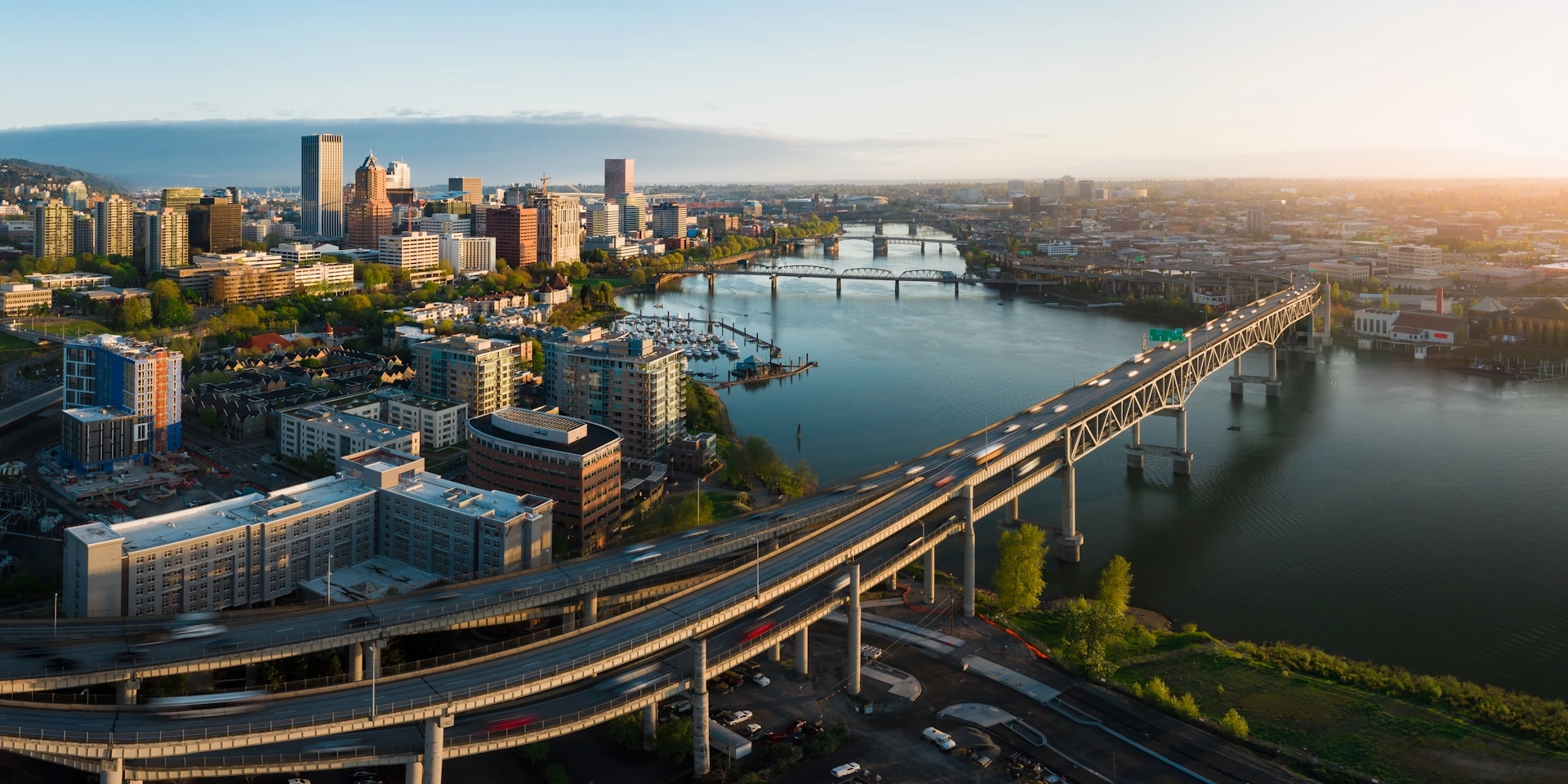
Portland remains the state's main mixed business market. It still carries the deepest office base, the strongest concentration of urban service demand, the broadest pool of business users, and the largest industrial platform in Oregon. That does not mean every Portland asset deserves core-market treatment. It means Portland is where pricing differences inside the same asset category become easiest to see. A real mixed business building, a service-driven urban retail property, a practical industrial building, and a weaker office asset may all sit under the same city label while behaving very differently.
For buyers, Portland now rewards selectivity more than automatic confidence. The stronger office and mixed business assets are usually the ones that already fit a clear user base, whether that is professional services, healthcare-linked demand, creative and service work, or denser mixed-use activity. The stronger industrial assets are the ones with a visible operating task, not just a warehouse label. A cleaner acquisition in Portland usually comes from submarket fit, not from assuming the city name does the underwriting by itself.
The Willamette Valley gives Oregon a steadier commercial middle
The Willamette Valley changes how Oregon should be compared because it creates a broader commercial middle rather than a secondary version of Portland. Salem, Eugene, Springfield, Corvallis, and the surrounding business areas support government activity, education, healthcare, local services, food and manufacturing support, and practical industrial use. This makes the Valley one of the most useful places in Oregon for buyers who want buildings tied to everyday economic use instead of headline-driven pricing.
In this part of Oregon, the better asset is often not the most visible one. A medical office building with repeat demand, a flex property serving local operators, a practical warehouse supporting food, distribution, or contractor activity, or a neighborhood retail center with clear spending patterns can all make more sense than a louder concept imported from Portland. Commercial real estate in Oregon becomes easier to price once the Valley is read as its own demand system rather than as overflow from the main metro.
Central Oregon changes the asset hierarchy in Oregon
Central Oregon, led by Bend and the surrounding market, shifts the commercial reading again. This is one of the clearest places where healthcare, hospitality, local services, recreation-linked business activity, and smaller industrial or flex demand all matter at once. It is not a classic office market, and it is not just a tourism market either. That is why buyers who try to force one category lens onto Central Oregon usually miss what actually holds value there.
The cleaner acquisitions in Central Oregon often come from service-heavy property with visible users. Medical office, mixed commercial buildings tied to year-round residents, hospitality that is not dependent on one season alone, and practical industrial or flex space serving local operators can all be stronger than a building that looks more sophisticated but has a weaker daily purpose. Buy commercial property in Oregon through this lens and Bend becomes a functional regional market, not just a lifestyle location with retail and hotels.
Southern Oregon makes service and owner-user property easier to read
Southern Oregon brings another commercial role that buyers often overlook. Medford and the Rogue Valley are not trying to compete with Portland, and they do not need to. Their commercial value usually comes from healthcare, regional services, local distribution, food and agricultural support activity, hospitality in selected pockets, and smaller owner-user business space. That makes the market easier to read through practical use rather than through a broad growth narrative.
This matters because some of the cleaner acquisitions in Oregon sit in markets like this. A neighborhood center with repeat local demand, a medical or service building near stable traffic, or a flex asset with an obvious operator base can be easier to underwrite than a more fashionable property elsewhere. Southern Oregon often rewards clarity over scale. The asset works because the local market needs it, not because the property carries a big-city identity.
Coastal Oregon should not be bought as pure hospitality
Coastal Oregon is one of the easiest parts of the state to misprice because visitor demand is real but incomplete as an explanation. Hospitality matters, but so do marine services, local retail, food and beverage, maintenance and contractor activity, second-home support services, and year-round resident demand. A property on the coast should never be screened only through tourism language. The stronger coastal asset usually has more than one demand source behind it.
That can mean a hospitality property with durable shoulder-season use, a retail building that serves both visitors and locals, or a practical mixed commercial asset tied to marine, maintenance, or service activity. Weaker acquisitions often depend too heavily on peak-season narrative. Stronger ones fit the daily commercial rhythm of the town even when visitor volume changes. VelesClub Int. helps buyers keep that distinction sharp because coastal Oregon can look stronger on image than it is on year-round function if the building is screened the wrong way.
What stronger commercial property in Oregon usually gets right
The strongest Oregon assets usually share one trait: the building role is obvious before the sales story begins. In Portland, that may mean a real mixed business or industrial function in the correct submarket. In the Valley, it may mean government, healthcare, education, food, or contractor demand. In Central Oregon, it may mean medical, service, hospitality, or flex use with visible year-round users. In Southern or Coastal Oregon, it may mean local service demand, regional trade, or a believable overlap between resident and visitor spending.
Weaker assets usually fail for a predictable reason. They borrow the wrong market story. A suburban building outside Portland gets marketed like a metro core asset. A coastal property gets sold as if seasonality does not matter. A small warehouse gets compared to a true distribution building even though its real use is contractor storage or local service supply. A retail unit looks attractive on frontage but sits outside the right spending pattern. In Oregon, pricing starts making sense only after the building's daily commercial task is clear.
This is why strategy fit matters more than category labels alone. Stable income tends to come from buildings serving repeat local use, medical demand, durable service corridors, or practical industrial tasks. Repositioning makes more sense where a building sits in a better lane than its current use suggests, not where the buyer is simply hoping a weaker market will become a stronger one. Owner-user logic is often more persuasive in smaller Oregon markets than broad investment narratives. The right strategy is the one that matches the market lane first.
Questions buyers ask about commercial property in Oregon
Is Portland always the best place to buy commercial property in Oregon?
No. Portland is the broadest mixed business market, but medical, owner-user, service, hospitality, and smaller industrial strategies can fit the Valley, Central Oregon, or Southern Oregon more naturally.
Where does warehouse property in Oregon make the most sense?
That depends on task. Portland carries the broadest industrial platform, while the Valley and regional markets often make more sense for food, contractor, manufacturing-support, or local distribution use.
Why can Bend or Medford assets be easier to underwrite than a louder Portland property?
Because healthcare, service demand, regional trade, and local user patterns can create a clearer daily occupancy base than a building relying too heavily on metro image.
Should office space in Oregon be screened the same way statewide?
No. Portland office, Valley service office, medical office, and smaller owner-user business space depend on different occupiers and should not share one comparison model.
What usually separates a better Oregon acquisition from a weaker one?
The better property already fits the market lane around it. The weaker one usually depends on a story imported from another part of the state.
A tighter Oregon acquisition view with VelesClub Int.
The practical way to read Oregon is to stop treating it as one Pacific Northwest story and start separating the state's working markets. Portland is the main mixed business and industrial core. The Willamette Valley is the steadier service and operating middle. Central Oregon is a healthcare-service-hospitality market with a different asset mix. Southern Oregon is often easiest to buy through owner-user, medical, and practical service logic. Coastal Oregon demands a stricter hospitality and mixed-use screen.
Once those lanes are clear, commercial property in Oregon becomes easier to judge by tenant base, building task, and market fit. That is where VelesClub Int. adds value. Not by making Oregon sound larger than it is, but by making it more exact. The stronger acquisition is rarely the one with the loudest statewide narrative. It is the one whose format, users, and local commercial role already work together.