
Commercial Property in BelarusBusiness assets enabling portfolio growth
Best offers
in Belarus
Benefits of investing in commercial real estate in Belarus


Ring economy
Belarus is often reduced to Minsk, yet commercial weight spreads through the Minsk ring, the western Brest corridor, the eastern Gomel axis, and separate industrial nodes where logistics and production outperform capital-office assumptions
Format fit
Readers often compare offices, warehouses, workshops, and mixed commercial buildings together, but Belarus separates them fast. Minsk suits management, Great Stone suits logistics, while Brest, Grodno, and Gomel fit corridor and trade-support property better
Wrong benchmarks
The common mistake is ranking assets by capital prestige or building quality alone. In Belarus, border orientation, rail access, industrial clustering, and customs-facing flow usually explain stronger commercial performance better than image
Ring economy
Belarus is often reduced to Minsk, yet commercial weight spreads through the Minsk ring, the western Brest corridor, the eastern Gomel axis, and separate industrial nodes where logistics and production outperform capital-office assumptions
Format fit
Readers often compare offices, warehouses, workshops, and mixed commercial buildings together, but Belarus separates them fast. Minsk suits management, Great Stone suits logistics, while Brest, Grodno, and Gomel fit corridor and trade-support property better
Wrong benchmarks
The common mistake is ranking assets by capital prestige or building quality alone. In Belarus, border orientation, rail access, industrial clustering, and customs-facing flow usually explain stronger commercial performance better than image








Useful articles
and recommendations from experts
Commercial real estate in Belarus by corridor, border role, and city function
Commercial real estate in Belarus has to be read through a compact but highly differentiated internal map rather than through one simple Minsk story. The country is not commercially flat. Minsk dominates offices, administration, finance-related services, technology, and the broadest urban service economy, but much of Belarusian commercial logic sits outside the capital. Brest follows a border-and-logistics reading tied to westbound movement. Grodno works through a western transit and industrial-service role of its own. Gomel belongs to the southeastern industrial and rail-oriented layer. Mogilev and Vitebsk support practical regional-service and industrial uses rather than deep office concentration. Around Minsk itself, the outer ring and the Great Stone side of the market carry a very different property logic from the core city. Once these roles are separated, Belarus becomes much easier to screen commercially.
This matters because Belarus is easy to misread in two opposite ways. One mistake is to treat everything as an extension of Minsk and assume the strongest version of every office, warehouse, hotel, showroom, and mixed-use building must somehow sit in or next to the capital. The other is to flatten the country into one transit economy and ignore the fact that offices, warehouses, industrial compounds, border-facing trade property, and regional service buildings still answer different local demand engines. An office floor in Minsk, a warehouse near the western border, a logistics-support property in the Great Stone side of the market, an industrial-support building in Gomel, and a practical mixed-use asset in Mogilev do not belong in one comparison group. The stronger shortlist starts with city role, corridor function, and whether demand comes from management, storage, production, customs-facing movement, or local services before it starts with the property label itself.
How the Belarus commercial map actually works
The clearest way to read Belarus is through six connected layers. The first is Minsk, which remains the main market for offices, administration, finance-related services, healthcare, education-linked business, hospitality, and higher-order mixed-use. The second is the outer Minsk belt, including the airport side and the Great Stone area, where logistics, warehousing, distribution, and large-scale practical commercial property fit more naturally than inner-city office stock. The third is the western border corridor, especially Brest and to a lesser degree Grodno, where customs movement, trucking, warehousing, and trade-support property matter more than prestige office demand. The fourth is the southeastern industrial layer around Gomel, where rail, manufacturing, logistics, and heavy operational uses create another property logic. The fifth is the central and eastern regional-service layer around Mogilev, where practical mixed-use, healthcare, education, and town-scale commercial buildings make more sense than symbolic office products. The sixth is the northern layer around Vitebsk, where regional services, practical logistics, and industrial support create a narrower but still meaningful commercial pattern.
This structure is more useful than broad national language because Belarus does not support all commercial formats equally in all cities. Office property belongs first in Minsk. Large logistics and distribution assets belong more naturally in the outer Minsk ring and on the western corridor. Border-facing warehousing and trade compounds fit Brest more clearly than a capital-style office comparison. Industrial-support and rail-oriented property fit Gomel much better than a prestige urban benchmark. Regional service buildings, local hotels, healthcare-oriented assets, and practical mixed-use fit Mogilev and Vitebsk more naturally than deep formal office stock. Once those roles are separated, the same building type stops being compared against the wrong market.
Minsk as the main office, service, and management market
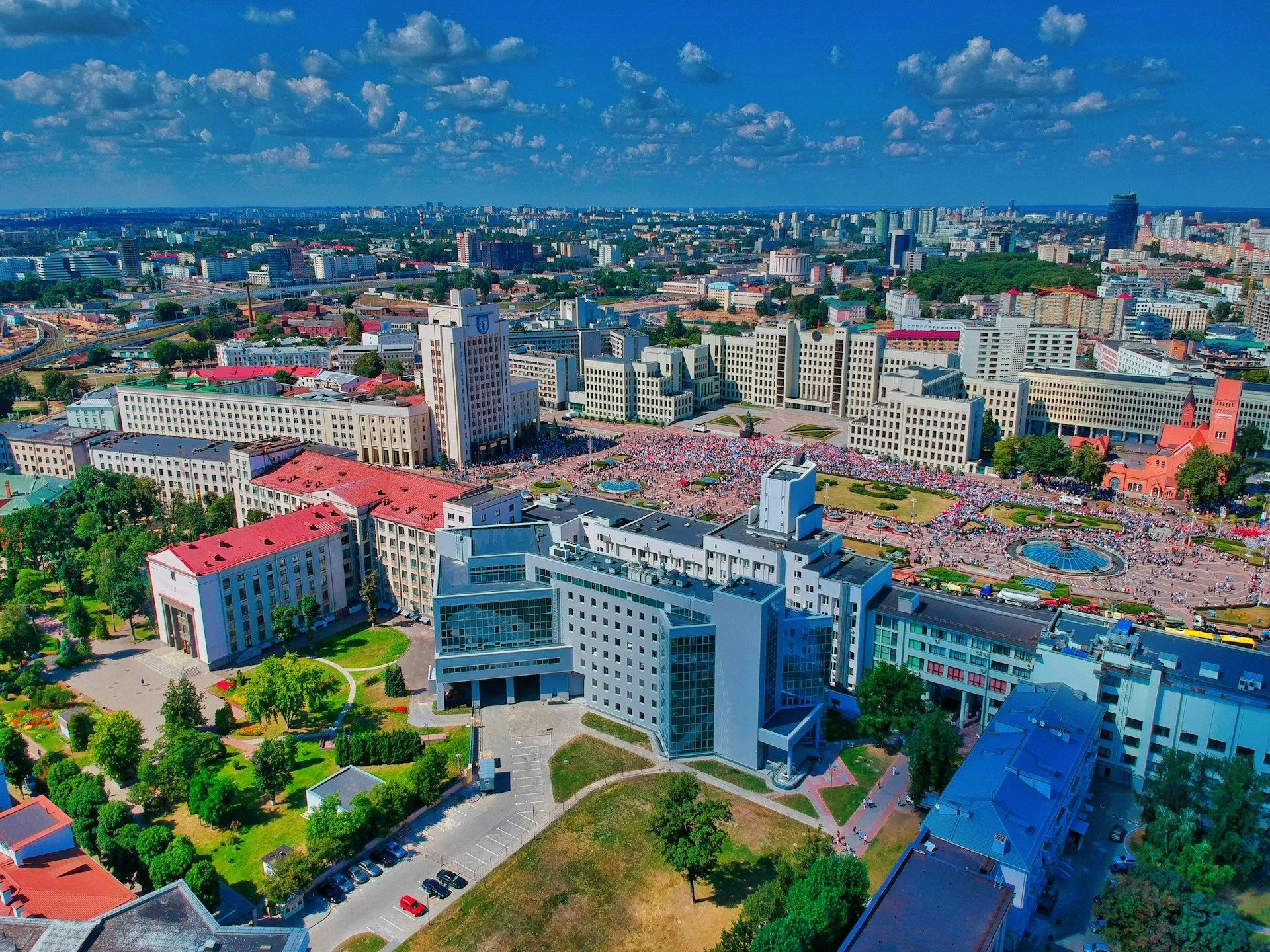
Minsk remains the natural reference point for office property because it concentrates ministries, state institutions, banking-related services, technology firms, healthcare, education, retail, and the broadest formal urban economy in Belarus. This makes Minsk the clearest market for office buildings, clinics, education premises, service-heavy mixed-use property, business hotels, and customer-facing commercial buildings tied to daily urban movement. In commercial terms, Minsk matters because it brings together decision-making, management, and the deepest year-round tenant base in the country.
That said, Minsk should not be treated as one uniform office field. Central business districts, newer business zones, and practical peripheral service areas all perform differently. Some parts of the city fit administration, finance, consulting, and higher-order office users more naturally. Others work better for healthcare, education, hotels, neighborhood services, and mixed-use buildings that need easier road access and stronger daily local use. The stronger asset in Minsk is therefore not automatically the one with the most visible address or the most polished facade. It is the one whose building type matches access, parking, user routine, and the actual service ecosystem around it.
This is one of the first comparison mistakes buyers make in Belarus. They assume that because Minsk dominates formal business activity, it must also be the benchmark for every other kind of commercial property. In practice, it is strongest where management, offices, technology, healthcare, and formal services matter. It is a much weaker benchmark for warehousing, cross-border logistics, or utility-heavy industrial-support property elsewhere in the country.
The outer Minsk belt and Great Stone as the main logistics extension
The outer Minsk side of the market should be screened separately because this is where a large share of the country's practical logistics and large-format commercial use becomes clearer than in the city core. The airport-facing belt and the Great Stone side of the market support warehousing, cargo handling, trade-support buildings, contractor facilities, storage, and large mixed-use logistics property far more naturally than prestige office stock. The stronger asset here is usually one aligned with movement, access, and utility rather than symbolic centrality.
This is one of the biggest market corrections in Belarus. Buyers often compare an outer-ring logistics property with a city-center office as if both belonged to one metropolitan hierarchy. In practice, they do not. The stronger building near the airport or Great Stone is usually the one that solves loading, truck movement, storage, yard use, or distribution problems. A more practical site can therefore be commercially stronger than a more polished urban building if the real tenant base depends on movement, staging, and supply rather than formal services. The right benchmark is operational usefulness, not city-center image.
This outer belt also explains why Belarus should not be screened through inner-city language alone. Some of the country's clearest large-format commercial assets sit outside the core because that is where logistics and distribution can actually function at scale. In a compact country with a strong capital region, this distinction is commercially decisive.
Brest as the main western border and customs market
Brest belongs to another commercial lane and should not be screened as a weaker version of Minsk. Its stronger role comes from the western border, customs flow, trucking, warehousing, trade support, and practical hospitality linked to repeated cross-border movement. This makes Brest one of the clearest places in Belarus for warehouses, logistics compounds, customs-facing service buildings, roadside hotels, and practical mixed-use property tied to movement rather than formal office prestige. The stronger property there is usually one aligned with border utility.
This is one of the most useful corrections in Belarus. Buyers often compare Brest through city size or historic identity and miss the specific strength of its corridor role. A stronger asset there is usually one that captures freight flow, customs timing, truck services, storage need, or business tied to border circulation. A practical warehouse or service compound can be more commercially legible than a more polished office-style property if the user base depends on handling and transit rather than on white-collar office demand. The right benchmark is corridor function, not symbolic status.
Brest therefore broadens the national map decisively. Belarus is not only a Minsk office market. It also contains a western gateway where storage, customs, and trade-support property have a very clear commercial logic of their own. That difference should always appear in a serious shortlist.
Grodno as the western transit and industrial-service city
Grodno belongs to another category again and should be screened through western transit, industry, regional services, and practical trade activity rather than through a capital-style office comparison. Its stronger role comes from manufacturing, processing, local service demand, and west-facing commercial movement. This gives Grodno a more natural fit for industrial-support buildings, practical offices, service-heavy mixed-use, healthcare-oriented assets, local hotels, and storage tied to regional trade rather than for high-prestige office towers.
This distinction matters because Grodno is often compared too loosely with both Brest and Minsk. In practice, it is not simply a border warehouse market and not simply a smaller capital. A stronger property in Grodno is usually one that fits local services, industrial support, practical hospitality, or moderate trade-related storage correctly. A healthcare-oriented building, a practical mixed-use property, or a local service office can be more commercially legible there than a formal office tower or oversized logistics compound. The better asset is usually the one that matches the city's mixed industrial and service character.
Grodno also shows why the western side of Belarus should not be treated as one single market. Brest is strongest where customs-facing movement dominates. Grodno is stronger where regional services and industrial support combine with western access. That difference is commercially important.
Gomel as the southeastern industrial and rail-oriented market
Gomel belongs to another commercial lane and should be screened through industry, rail position, manufacturing support, storage, and utility-heavy commercial use rather than through office assumptions. This makes Gomel stronger for workshops, industrial compounds, warehouses, transport-facing service buildings, practical hotels, and mixed-use property tied to repeated operational demand. The stronger asset there is usually one aligned with rail, production, and practical movement rather than with formal urban prestige.
This is another major correction in Belarus. Buyers often compare Gomel by city size or general regional status, but its stronger property logic is more specific. A stronger asset there is usually one that supports manufacturing, repair, storage, contractor activity, or transport-linked business. A practical industrial or warehouse property can be more commercially legible than a polished office-style asset if the real tenant base depends on operations and not on formal management demand. The right benchmark is production support and route function.
Gomel therefore matters commercially in a very different way from Minsk. It does not compete with the capital for deep office concentration. It is strongest where heavy practical use, rail utility, and industrial support create repeated working demand. That should be visible in any serious country page.
Mogilev and Vitebsk as regional service and practical mixed-use cities
Mogilev and Vitebsk should be screened more narrowly than Minsk, Brest, or Gomel. Their stronger role comes from healthcare, education, local administration, practical mixed-use, moderate industrial support, and town-scale hospitality rather than from deep capital-style offices or major border warehousing. This makes them more natural for clinics, schools, service buildings, modest hotels, practical mixed-use, and storage tied to regional distribution rather than for symbolic high-image assets.
This is an important correction because secondary cities in Belarus are often described as if they simply await larger-scale office growth. In practice, the stronger property in Mogilev or Vitebsk is usually one that fits repeated local demand correctly. A healthcare-oriented building, an education-linked commercial property, a practical hotel, a service-heavy mixed-use block, or a moderate warehouse serving regional supply can be more commercially legible there than a formal office product with no clear tenant base. The right benchmark is local service depth and daily use.
This does not make these cities weak. It makes them narrower. In Belarus, regional-service property can be very clear commercially when it is judged through practical local demand rather than borrowed capital prestige or border-corridor logic. That narrower reading usually produces a much stronger shortlist.
What makes one commercial asset stronger than another in Belarus
The stronger commercial asset in Belarus is usually the one aligned with the correct local demand engine. In Minsk, that engine is administration, services, healthcare, education, technology, and formal business activity. In the outer Minsk belt, it is logistics, cargo, storage, and distribution. In Brest, it is customs flow, trucking, and cross-border warehousing. In Grodno, it is regional services, practical industry, and western movement. In Gomel, it is rail, manufacturing, storage, and industrial support. In Mogilev and Vitebsk, it is local administration, healthcare, education, practical mixed-use, and regional supply.
This is why common shortcuts fail. A capital address is not enough. A border-side location is not enough. A larger plot is not enough. A newer facade is not enough. In Belarus, the stronger property is usually the one that solves a real access, storage, service, labor, or movement problem in the place where it sits. Commercial value becomes clearer when the building is matched to its corridor, city function, and user base rather than judged by image alone.
FAQ on commercial property in Belarus
Why is Minsk still the key office market in Belarus
Because it concentrates administration, services, healthcare, education, technology, and the broadest formal business environment, which gives office and service-heavy property the strongest tenant base in the country.
Why should the outer Minsk belt be screened differently from central Minsk
Because its commercial logic comes from cargo access, storage, distribution, and logistics-related utility. Warehouses and large practical business sites fit more naturally there than central office products.
What makes Brest commercially different from other Belarusian cities
Its stronger role comes from customs flow, western trucking routes, border warehousing, and trade-support services. Practical logistics property often fits more naturally there than capital-style office stock.
How should Gomel assets be compared
They should be compared by rail utility, storage need, industrial support, and production-linked demand. A warehouse, service yard, and office floor do not answer the same Gomel market.
Why are Mogilev and Vitebsk not just smaller versions of Minsk
Because they work through regional services, healthcare, education, practical mixed-use, and moderate distribution rather than deep management and office concentration. Their stronger assets usually serve repeated local demand.
How to shortlist Belarus more accurately
A practical shortlist in Belarus starts with one question: what kind of activity keeps this property commercially active day after day. If the answer is administration, technology, healthcare, education, banking-related services, or formal customer-facing demand, Minsk should come first. If the requirement is cargo, storage, distribution, and large-format logistics, the outer Minsk belt and the Great Stone side of the market become more relevant. If the use depends on customs flow, trucking, and border-facing warehousing, Brest should move higher. If the property serves regional services, practical industrial support, and moderate western trade activity, Grodno should be screened through that mixed corridor lens. If the asset depends on rail utility, industrial support, and production-linked storage, Gomel belongs in a separate southeastern operational shortlist. If the use depends on healthcare, local administration, practical hospitality, and service-heavy mixed-use, Mogilev and Vitebsk should be judged through regional catchment rather than compared directly with the capital or border gateways.
That node-by-node and corridor-by-corridor method works because Belarus is commercially concentrated but not commercially simple. The country only becomes clear when Minsk is separated from its logistics ring, when Brest is recognized as the main customs gateway, when Grodno is judged through mixed western utility, when Gomel is read as an industrial and rail-oriented market, and when Mogilev and Vitebsk are screened by practical regional-service logic rather than borrowed capital prestige. The stronger shortlist is almost always the one built on those distinctions instead of on broad labels such as central, strategic, or prestigious.